← Artificial Intelligence
Social Media
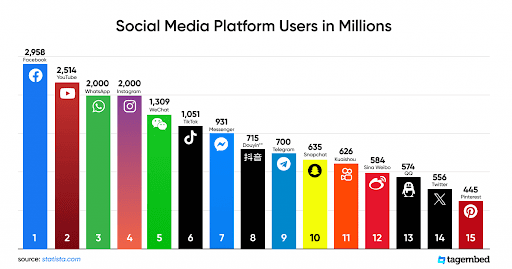
In 2024, over five billion people used social media platforms like Facebook, YouTube, Instagram, and TikTok. These platforms shape how people connect, interact, and get informed — while harvesting personal data and using AI to promote content that can reinforce bias, polarize opinions, and spread misinformation.
Bibliography
- https://www.statista.com/statistics/278414/number-of-worldwide-social-network-users/?__sso_cookie_checker=failed (CITER)
- Hedderson, M. M., Bekelman, T. A., Li, M., Knapp, E. A., Palmore, M., Dong, Y., Elliott, A. J., Friedman, C., Galarce, M., Gilbert-Diamond, D., Glueck, D., Hockett, C. W., Lucchini, M., McDonald, J., Sauder, K., Zhu, Y., Karagas, M. R., Dabelea, D., Ferrara, A., & Environmental Influences on Child Health Outcomes Program. (2023). Trends in Screen Time Use Among Children During the COVID-19 Pandemic, July 2019 Through August 2021. JAMA Network Open, 6(2), e2256157. https://doi.org/10.1001/jamanetworkopen.2022.56157
- Bhargava, V. R., & Velasquez, M. (2021). Ethics of the Attention Economy : The Problem of Social Media Addiction. Business Ethics Quarterly, 31(3), 321‑359. https://doi.org/10.1017/beq.2020.32
Data →